

Pros
- Fantastic bass
- Portable design with big sound
- Auracast, stereo, and lossless audio support
- Generous battery life with Playtime Boost
Cons
- Doesn’t come with a USB-C cable
- Not backwards compatible with older PartyBoost speakers
- Slightly too big to travel with
- You may have to make frequent EQ adjustments
Summer is almost here and that means the good weather that comes with it. This might also mean trips to the beach, days and weekends by the pool, and time spent up at the cottage. Music is a big part of that equation, and JBL is one of those brands with a diverse line of outdoor, water-resistant speakers. One of the latest in the line is the JBL Charge 6, a portable Bluetooth speaker with big sound.
About the JBL Charge 6 Portable Bluetooth Speaker

The JBL Charge 6, available in Canada through Erikson Consumer, sells for about $250. Available in five solid colours as well as camouflage, it boasts new JBL proprietary technology called AI Sound Boost, which analyzes your music in real time to provide “maximum acoustic performance with less distortion.”
Along with AI Sound Boost, you get traditional powerful JBL sound through the 30W RMS output power for the woofer and 15W RMS for the tweeter. This includes support for lossless audio playback. Control it using the JBL Portable app.
Get up to 24 hours of playtime per charge, and an extra four hours in a pinch using JBL Playtime Boost. You can pair two Charge 6 speakers for stereo sound, perfect for positioning one at either side of the pool or on the deck. You can also connect multiple JBL speakers with Auracast, including other models, to get more immersive sound throughout a larger area like a basement or backyard.
The speaker is IP68 water and dust resistant and drop-proof. In fact, it can withstand drops from as high as one meter onto even concrete floor. (We’ll have to take their word for it as I wasn’t inclined to test this with my review sample!) Based on lab test conditions, you should be able to submerge this speaker in up to 1.5 metres of freshwater (not saltwater) for up to 30 minutes.
It comes with a handle strap, USB-C port (cable not included), and Bluetooth 5.4 A2DP. As its name implies, you can also use this portable speaker as a power bank to recharge your phone.
JBL Charge 6 Review

If the JBL Flip 7, which I reviewed earlier this month, is the portable Bluetooth speaker you want to take with you on vacation, the JBL Charge 6 is the bigger sister you’re more likely to leave on your desk at work or in the home office, bring around from room to room in the house, and use by the pool or take with you up to the cottage or a friend’s house.
It’s portable but not quite as portable as that model, with more heft to it (it weighs 3 lbs. compared to the Flip 7’s 1.82 lbs.) But don’t be mistaken: this is still a small speaker that you can easily pop into a beach bag or the car for a camping trip.

The unit looks virtually identical to the Flip 7 with the addition of a flat bottom with rubber grips so it sits more firmly on a table or desk. It has the same controls at the top and a handle for easily carrying it around. The same exclamation point symbols on either side pulse along with the bass of your tunes as you listen while the JBL symbol appears prominently on the front.
The design of the JBL Charge 6 not only reminds me of the Flip 7 but also the JBL Boombox 3 that I reviewed last year. In fact, it sort of looks like a miniature boombox. JBL has a signature look across all its portables, and that’s a good thing, especially since you can link so many together for a more immersive listening experience. As you expand with new models, it doesn’t look like you have a bunch of mismatched speakers throughout the house or backyard. With that said, because this speaker uses Auracast versus JBL’s PartyBoost, you can’t connect it with older-model options.
I enjoyed listening to a mix of tunes from sources like Apple Music and SiriusXM throughout my review period of a few months. Naturally, like most JBL speakers, this one especially excels when it comes to producing pronounced bass. If you love to crank up the tunes at a party, two of these at $500 would do a pretty decent job for an average-sized basement or even backyard.
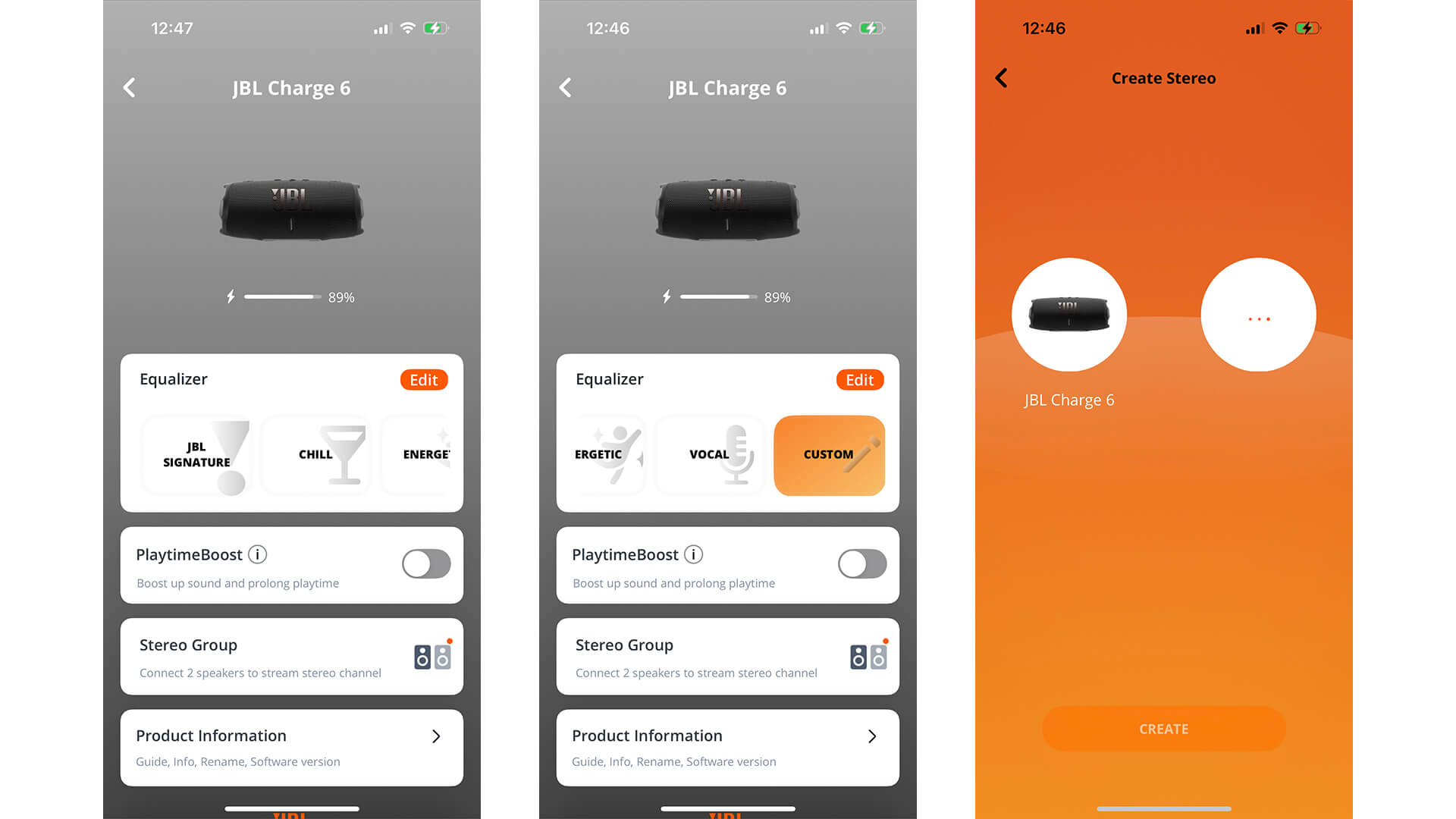
Of course, with every audio product review, I pop on my reference track, Radiohead’s “Creep.” While I had to make some adjustments to mid-range and treble to get the sound just right using my own custom EQ setting in the JBL Portable app, once I found the perfect balance, every emotional vocal, note, guitar string, and beat of the drum was reproduced as expected and desired. For this particular tune, the default JBL Signature EQ preset just didn’t fit.
Turning on Playtime Boost, which is designed to reduce bass to conserve battery, the song became harsh at a high-volume level. I found the same result with other tracks. The verdict is that the feature is a great option if you’re spending a day at the beach and the speaker is about to die when you have nowhere to charge it. Squeak out more background music, ideally at a lower volume, until you’re ready to pack up. Playtime Boost is an appreciated feature that will help you get as much as four more hours of playtime out of the speaker. You’ll sacrifice sound quality to get it, but it’s better than no background music at all.
Turning Playtime Boost off and continuing with other tracks like Oasis’ “Wonderwall,” the vocals some clear and concise, beautifully reproduced for private listening at home or on the go. Going back to the JBL Signature EQ setting was perfect for this track, but songs like Sabrina Carpenter’s pop hit “Manchild” better suited a setting like Chill or my custom setting. Bottom line: you might have to play around with EQ setting to find the right balance for your ears and the type of music you love.
JBL Charge 6 s. JBL Charge 5
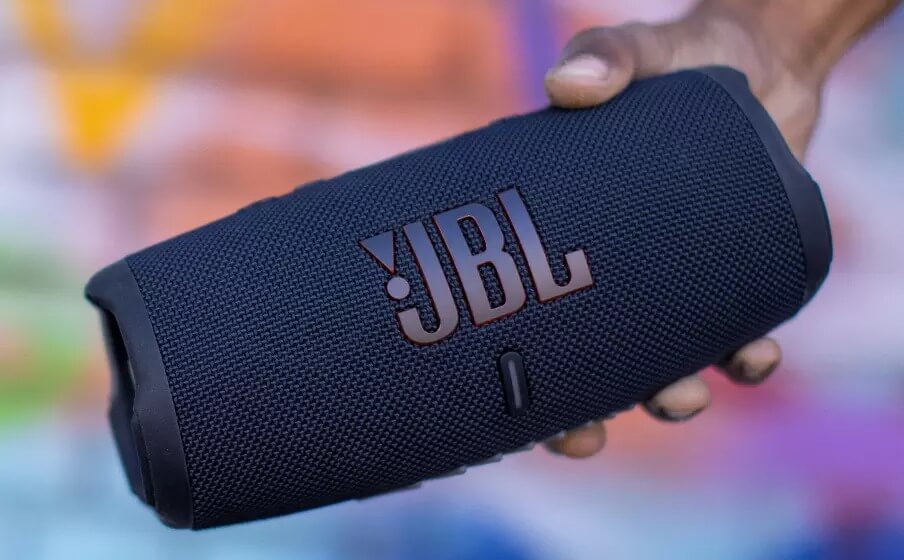
How does the JBL Charge 6 compare to the previous generation JBL Charge 5, which was released way back in 2021? Expectedly, there have been a lot of improvements.
It’s more durable with an IP68 rating versus IP67. It boasts a longer rated battery life of 24 hours (28 with Playtime Boost) versus 20 hours. It also has quick charge capabilities and Playtime Boost, which extends battery life at the expense of bass response. It now comes with the detachable handle, and has a wider and flatter base, so it’s more stable when you set it down. Audibly, the Charge 6 includes access to four more EQ presets than the Charge 5 for a total of seven and now supports lossless audio playback.
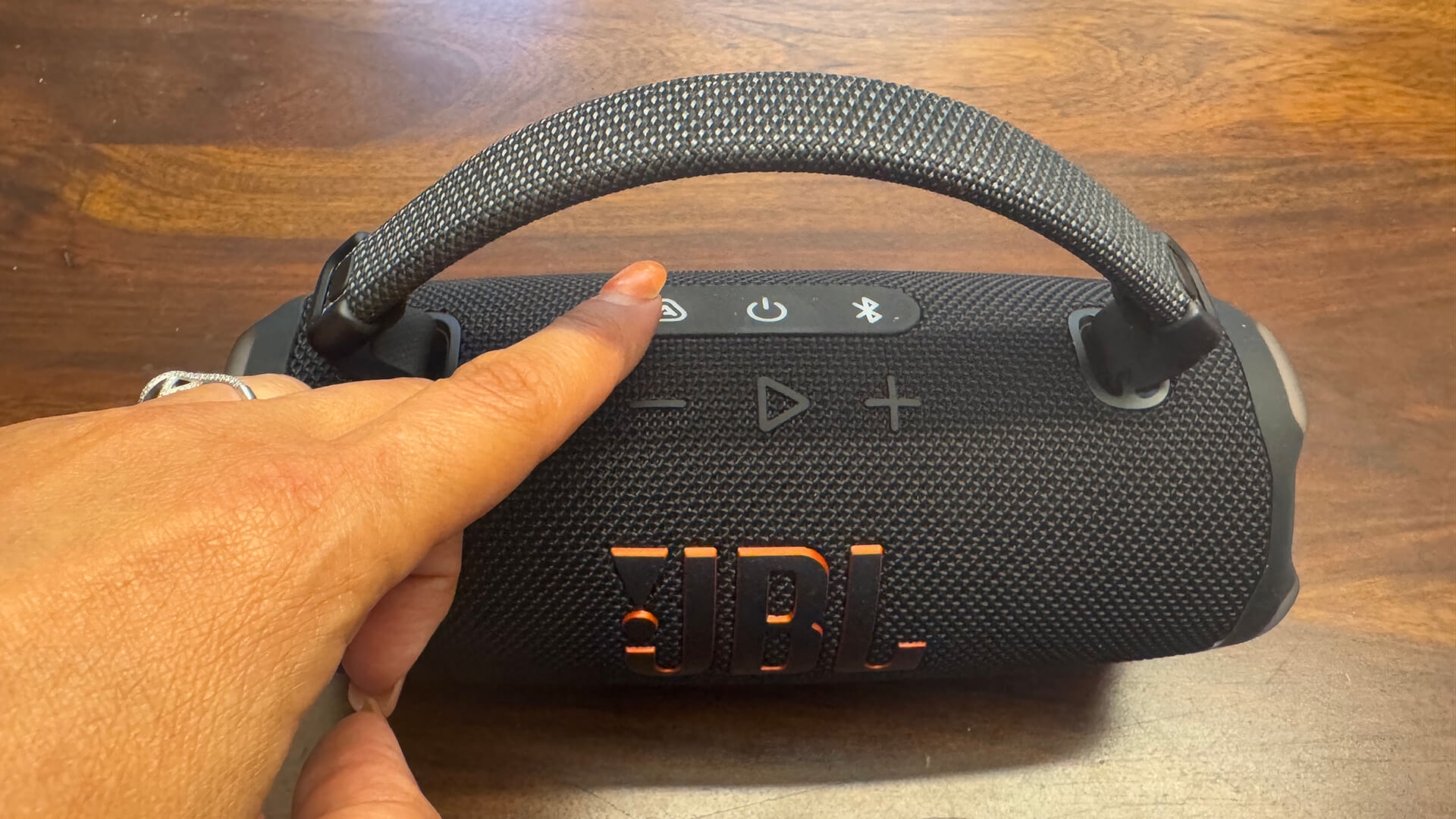
PartyBoost, a feature that made it easy to link multiple JBL speakers together, has been replaced by Auracast. This means you can’t link the two together. There’s also Bluetooth 5.4 connectivity versus Bluetooth 5.1, so you can expect a more stable connection.
As the name implies, this is a Charge model, which means you can use the port on the back to draw power to charge a connected device. But now, the Charge 6 includes a USB-C port while the Charge 5 had USB-A.
Should You Buy the JBL Charge 6?
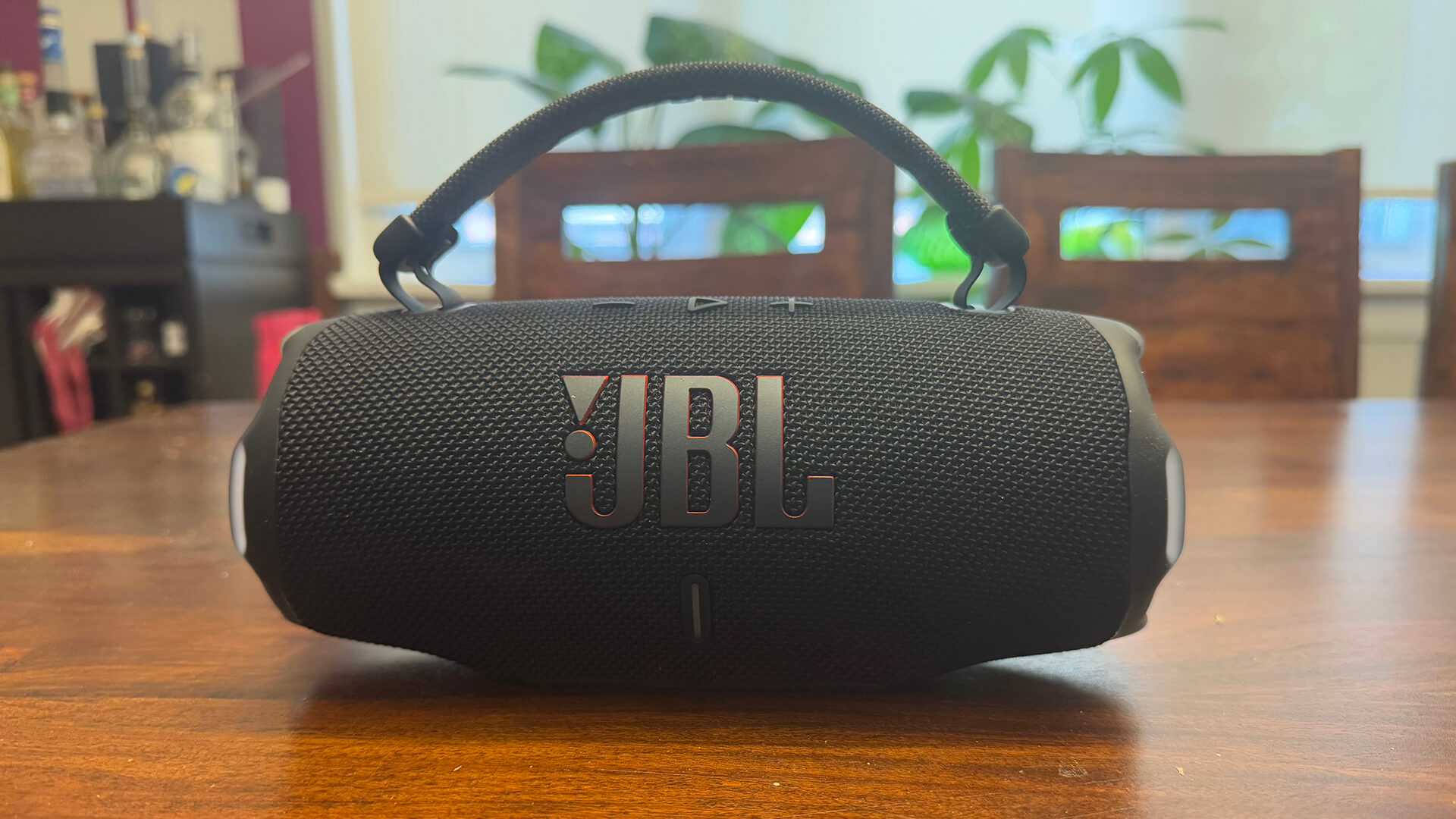
The JBL Charge 6 is a Goldilocks option in the portable Bluetooth speaker space. It’s not one of the smallest Bluetooth speakers you can buy and toss into your bag, but it’s not so big that you won’t want to take it out of the house. It’s about the size of a large Stanley cup with, of course, more heft to it. But it’s easy to move around from room to room thanks to the handle, bring with you in the car to the campsite, or even take to the beach or pool if you have a bigger bag or you’re OK carrying it by hand.
You’ll get fantastic sound, great battery life, and the option to pair it with other compatible Auracast JBL speakers if you have them, or plan to expand. At $250, it’s an affordable and versatile speaker that you will enjoy listening to all types of music on, with an app that gives you the freedom to tweak sound to your liking based on your personal preferences.
If you want something smaller, go with the JBL Flip 7. The great news is that if you decide that one doesn’t meet your needs, you can add the Charge 6 to the set-up and enjoy even more immersive sound when you want it or choose which one best suits the particular use case at the time.