

Pros
- Fantastic battery life
- Intuitive, well-organized app
- Tons of additional features in the app
- Smart Sensing helps eliminate gaps in tracking
Cons
- Expensive
- Subscription required
For the last several years, I have reviewed smart rings from companies like Samsung, Ultrahuman, Noise, Amazfit, and Circular. But there’s one company that has always led the pack: Oura. Finnish health technology company Oura Health Ltd. launched its first smart ring way back in 2013 via Kickstarter, and it was made available to customers by 2015. It took off and smart rings became a sign of prestige, worn by corporate raiders and health fanatics.
In the decade since, Oura has improved on its product, launching several new models. The most recent one is the Oura Ring 4. But now, the company is facing steep competition from other brands in the space, including established companies as well as start-ups. The big differentiator is that Oura requires a monthly membership fee while others do not. Is it worth it? I set out to find out.
The Oura Ring 4 Design

The Oura Ring 4, which replaces the Oura Ring Gen 3, is lightweight with an all-titanium design – yes, that includes titanium on the inner loop as well as the outer exterior. Unlike the Oura Ring 3, it’s entirely circular in shape giving it a sleeker look. It also has recessed sensors for a thinner profile versus the small bumps that were visible on the underside of the Oura Ring 3. This also makes it more comfortable for 24/7 wear. Further, this eliminates those stray lights you might be familiar with seeing glowing from the underside of the ring at night.
It comes in an expanded range of 12 sizes (4-15) and in Brushed Silver, Gold, Rose Gold, Silver, Stealth, and an updated Black finish that features a glossy, tungsten PVD coating for improved durability and a deeper black look.
The Redesigned Oura App and Smart Sensing

Complementing the new hardware, Oura has also redesigned its Oura app for both iOS and Android. It provides a more streamlined, at-a-glance view of both daily and long-term health metrics.
One of the key new features for the Oura Ring 4 is called Smart Sensing? This technology works with research-grade sensors to adapt to your finger and deliver more accurate and continuous data. It takes into account things like differing skin tones, excess flesh on the finger versus bonier fingers, those who tend to sweat more, as well as the ring shifting around through the day and night.

Thanks to the sensors having more than double the number of available signal pathways from eight to 18 compared to Oura Ring 3, you get continuous, accurate data in any situation. This includes if the ring moves around on your finger at night or even as you fidget by habit. The goal is to minimize gaps in the data when the sensor might not be in the perfect position on the underside of your finger. The feature also optimizes battery life so you get up to eight days (versus seven with Oura Ring 3).
Is The Subscription Worth It?
One thing to note about Oura Ring is that it requires a membership to get the most out of the experience. There are many competing smart rings on the market that offer a similar breadth of tracking but don’t require a subscription. Oura says its data is backed by science, and you get a completely private app experience.
As the saying goes, if you’re not paying for the product, you are the product. This isn’t to say that every other smart ring maker is collecting and selling your data. But Oura is steadfast in confirming that the experience in the app, and your data, remains completely private. You also won’t get in-app advertising, though many other smart ring apps don’t include that either.

Oura Ring is adding new capabilities with this membership. Chief among these is Automatic Activity Detection (AAD), which provides an even more comprehensive view of activity with the addition of automatic heart rate detection and heart rate zones. This means you no longer need to log heart rate manually. There are also new features like stress & resilience, women’s health with menopause and perimenopause tracking, heart health, and soon metabolic health.
Based on historical data, an Oura representative tells WiFi HiFi that there’s a 93% conversion rate with members after the free one-month trial. Oura Ring 4 starts at $470 in Canada. A one-month membership is included with purchase, after which it’s $8/mo. or $90/yr. Sacrifice a single Starbucks grande latte with a double shot of espresso each month, and you’re in.
Set-up, Wear, and Basics

As with any smart ring, you’ll need to order a sizing kit first to find the right fit. Wear it for 24 hours to account for fluctuations in the diameter of your finger (yes, it changes throughout the day and for women, at different times of the month as well). Once you know your size, return the kit and get your official ring. From there, you’ll need to sign up for a membership to take advantage of all the tracking the ring has to offer.
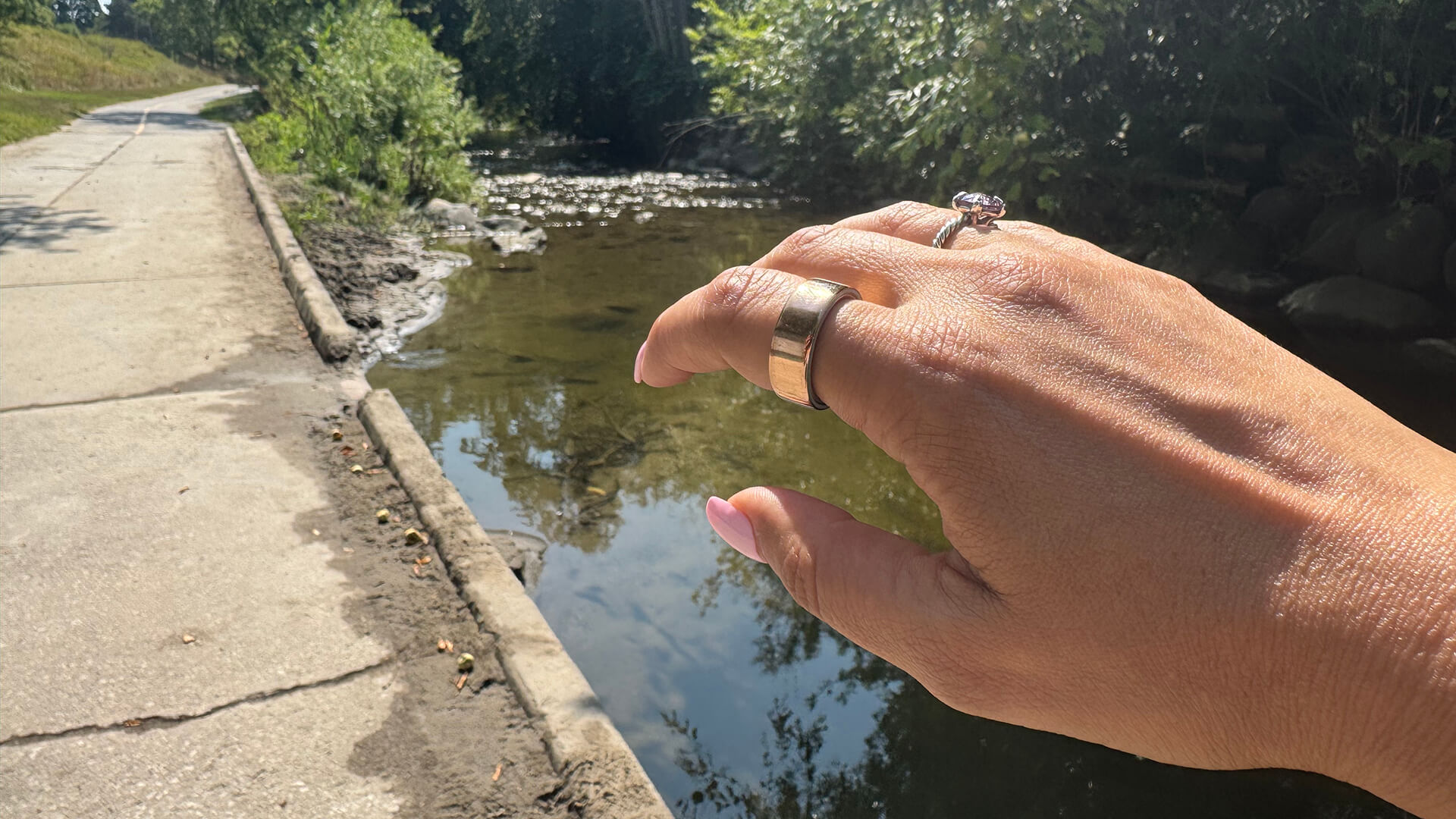
I received a size 8, which fits nice and snug. It doesn’t come off easily but it’s not too tight such that I have trouble removing it with a little tug. My review sample is finished in Rose Gold, a lovely departure from the usual blacks and silvers. It looks like a piece of jewelry, but those who don’t have a bolder fashion sense can opt for one of the more subdued hues.

It’s ultra-comfortable, easy to forget I’m even wearing it. It doesn’t get in the way of activities, whether that’s working out while holding dumbbells, typing away during the day, or even washing dishes. I do usually remove it to wash my hands or shower to avoid getting soap or shampoo on it. But it can indeed withstand all that, even a dip in the pool.
I love the rectangular notch on the bottom that guides you to how to place the ring properly on your finger and on the charger. The charging puck is nice, sitting flat on a table or other surface. My one wish for the ring would be a charging case like the one included with the Samsung Galaxy Ring, which would allow for recharging on the go. With that said, battery life is fantastic. So you could go for a week vacation without even bringing the charging puck with you.
The App Experience

The app is nicely organized with a scrollable list of daily data as well as circular menu options at the top and tabs for Today, Vitals, and My Health. It’s like a mix of apps I have used with other smart rings, like the Circular Ring Slim and the Ultrahuman Ring Air. It’s suggestive that these brands have taken elements from the Oura app and replicated them for their own companion apps.
Naturally, you’d expect an intuitive app experience with this ring given that you’re paying a membership fee, and it delivers. The redesign applies to all Oura Members with older-model rings as well, so you get all the same features with other Oura rings, with the exception of the Smart Sensing.
Let’s take a look at the relevant sections of the app.
Today Tab: At-a-Glance Details

The Today tab shows relevant information depending on the time of day and your unique biometrics and health goals. Shortcuts at the top of this tab view show Readiness, Sleep, Activity, [Menstrual] Cycle Day, Daytime Heart Rate, and Stress scores at-a-glance. Vitals provide more information on each of your scores, focusing on the ones that are most important to you.
My Health Tab: Check Your Vitals

The My Health tab highlights long-term metrics like Cardiovascular Age, Cardio Capacity, Stress Resilience, and Sleep Trends. You’ll note that it will take about two weeks before you start seeing data in this section as the ring captures your baselines and begins to analyze from there. Once my baselines were achieved, I was able to see that my resilience to stress is adequate (that tracks!), my cardiovascular age is aligned with my actual age (actually, 0.5-1.5 years younger – whoo hoo!), and my cardio capacity ranged from Excellent to Fair, depending on the day. You can do a six-minute walking test to get data on your V02 Max.
Daytime Stress: Understand Your Triggers

There’s a Daytime Stress feature to help you learn how to better handle periods of physiological stress. Looking at the handy graph can also help you understand causes of stress based on the times when it’s higher than usual. A paragraph underneath advises of the most recent measurement, 15 minutes prior.
Fertile Window and Women’s Health: Cycles, Perimenopause, Menopause

Use the Fertile Window to estimate fertile days, chance of conception at that time, and detected day of ovulation. You’ll see the menopause and perimenopause tracking features in the cycle insights area once available. Additionally, you can experiment with beta features like Symptom Radar (accessed from the menu button on the top, left of the app when in the Today tab) which can suggest if you might be getting sick, advising of minor, major, or no signs.
Meal Logging: Helpful Insights and Meal Regularity

For those looking to ensure they’re eating well, there’s a new meal logging feature where you can snap photos of your meals each day (or use text input) to keep an eye on your caloric and protein intake, as well as your eating habits in terms of portions, times, types, and consistency. It analyzes the data you enter and even provides feedback on the meal. For example, my yogurt with berries and oats combines probiotics with antioxidants to support gut and immune health, it advises, while the oats can help maintain healthy cholesterol levels.
It works intelligently, too. When I added that I had a hot dog for lunch (apparently it was good for a quick source of energy after my boxing workout that morning) it intelligently added the bun on the list of ingredients. There’s an “X” beside each one so you can remove items if needed.
You need to remember to log your meals every time you eat, which can eventually become a chore. For those on a diet, however, or looking to monitor their eating, it’s a couple minutes out of every day to keep a comprehensive log. Compared to other food logging apps, this is the most intelligent one I have used to date.
Oura Advisor: An Intelligent AI Assistant

Need help understanding what all your data means? Tap the Oura Advisor button in the “+” menu to access generative AI and converse about your health goals. It’s text-based and you can ask any basic question, such as “how am I looking today?” I asked this and was informed that my activity score was high with consistent movement and activity, readiness is moderate, but I didn’t have great quality sleep last night.
It attempted to continue the conversation by asking how I was feeling, to which I replied tired and stressed. Its response included helpful analysis advising that this is likely tied to my lack of sleep (no brainer there) and recommended a quieter evening as well as suggestions to wind down, like dimming the lights, eliminating screen time, or reading. It’s all common-sense advice, but it’s nice to have a virtual assistant help encourage you to do what you need with the actual data from your body to back it up.
Other Observations About the App

Overall, I love the circles at the top of the page that highlight the most important stats for each day, including readiness, sleep, activity, cycle day, heart rate, and stress minutes (you can also customize this to show whatever information you value most). It’s a nice snapshot that isn’t in your face and is easy to quickly glance at to get a feel for where you are.
I appreciate that activity goals adjust based on where you are in terms of readiness. For example, my baseline is set to a 300 active calorie burn per day, but on days when my readiness score was low, it would auto-adjust to 200. Every bit of data comes with not just a number but also insights. For example, I’m told my stress levels aren’t peaking but they are activated slightly, so I should focus on recovery.
Workout and Activity Tracking With Oura Ring

There are a few specific things I noticed when working out or doing activities. Along with being able to manually track a workout using the “+” sign on the bottom, right, the ring canautomatically track many types of workouts, which makes the process easier. This means you don’t need to grab for your phone and select the workout type and start and stop.
It would almost always recognize when I was on a walk but it’s not so perceptive for other types of workouts. Usually when strength training, it knows I was doing something but doesn’t know what. It eventually guessed, presumably based on a history of my activities. After a 30-minute boxing session, for example, it intelligently detected based on movements that this was the type of workout I was doing.

It sometimes picks up the workout at the wrong time, either much longer after you started or sometimes far longer after you were done. This might be irritating to those who are sticklers for details. Just keep in mind that you’ll have to be diligent in modifying the workout it picks up if it gets the wrong type or duration, or manually add ones that are missed. This is fairly standard with other smartwatches and rings with automatic workout detection as well. Unless the workout has very distinct motions, like running, boxing, or rowing, it might not detect it unless your heart rate spikes quickly, might detect it but not know what you’re doing, or might think you’re doing something else.
Nonetheless, I enjoyed not having to grab for my phone to manually start a workout every time I was about to do something like go for a walk. I also love that it picks up activities I might not have even manually logged on a smartwatch, like navigating through a shopping mall as a short walking workout, or practicing baseball in the backyard with my son.
Battery Life: A Huge Selling Feature

When it comes to battery life, this smart ring is top notch. I was blown away by how long it lasts. It’s usually about a week as stated, even with heavy usage including daily workouts, walks, and 24/7 tracking, including during sleep. It has the best battery life of any smart ring I have tested to date.
When it’s running low, you get a smartphone notification not only advising of that but indicating approximately how long you have left before it dies. Neat! The charging puck is sleek and matching notch helps with quick alignment as well as perfect positioning on your finger.
Should You Buy The Oura Ring 4?

Overall, the Oura Ring 4 is a fantastic smart ring, firmly among the best you can buy. It really comes down to that pesky subscription. At $90 per year, you’re effectively paying for another ring after five years, yet you’re still using the same one. I could justify this with the ample information provided in the app. But I’m having a hard time seeing how the data is any more advanced than what I have logged with other smart rings that don’t require a subscription.
Using my Apple Watch Series 10 as a comparative, which I have worn on the opposite wrist while reviewing every smart ring, they are all pretty in sync with one another when it comes to measurements for workout calorie burn, sleep data, respiration, and more, with slight variances. And there’s really no way to know which one is the most accurate.

But the Oura app is far more organized than others from third-party brands, some of which clearly drew inspiration from Oura in the app design. Plus, all the added niceties like the detailed women’s health tracking, symptom radar, and meal logging, are valuable added incentives. The reassurance that your data is private and the “backed by science” promises add to its value.
The Oura Ring 4 is my favourite smart ring to date, checking every box and then some. While I wish it didn’t require a subscription, after using it, I realize it’s a small price to pay for your health and wellness. We don’t balk at having to pay for streaming TV and music, video doorbell footage, software, and even gaming apps. Yes, it’s yet another monthly or annual charge to add to the list. But you can absorb the cost as a sacrifice for something less important (like one less grande latte with a pump of salted caramel and extra espresso shot a month!) and enjoy all the benefits this ring provides in helping you work towards improving your health, wellness, and fitness.
The Oura Ring 4 starts at $470 in Canada. A subscription is $8/mo. or $90/yr. and you get the first month free with purchase.